

The linked themes chosen by the World Federation for Mental Health Mental Health in an Unequal World and by the World Health Organisation Mental health care for all: let’s make it a reality present a sharp reminder of the difficulties we face in supporting good mental health, and a call to action to continue to try to.
Mental Health In An Unequal World
The United Nations writes:
This theme was chosen… because the world is increasingly polarized, with the very wealthy becoming wealthier, and the number of people living in poverty still far too high.
2020 highlighted inequalities due to race and ethnicity, sexual orientation and gender identity, and the lack of respect for human rights in many countries, including for people living with mental health conditions. Such inequalities have an impact on people’s mental health.”
The UN goes on to state that:
… access to mental health services remains unequal, with between 75% to 95% of people with mental disorders in low- and middle-income countries unable to access mental health services at all, and access in high income countries is not much better.”
Mental Health in an Unequal UK
The Centre for Mental Health in the UK published a factsheet outlining some of the inequalities. For example:
- Children from the poorest 20% of households are four times as likely to have serious mental health difficulties as children from the wealthiest 20%
- Children and young people with a learning disability are three times more likely than average to have a mental health condition
- People from African-Caribbean communities in the UK have higher rates of PTSD and suicide risk, and are more likely to be diagnosed with schizophrenia [as World Mental Health Day coincides with Black History Month, this is particularly pertinent and poignant]
and
- Women are ten times as likely as men to have experienced physical and sexual abuse.
These factors are of course reflected in schools. And while they may present very differently in the context of each educational setting, it is clear that schools have a vital part to play not only in managing the consequences, but also in helping set in place the foundations for potential change.
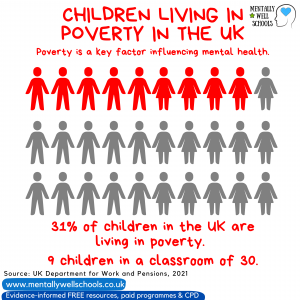
Marcus Rashford, England footballer and campaigner to end child food poverty in the UK, said of food poverty and its effects on children’s mental and physical wellbeing:
Education is only effective when children can engage in learning. Right now, a generation who have already been penalised during this pandemic with lack of access to educational resources are now back in school struggling to concentrate due to worry and the sound of their rumbling stomachs.”
Mental Health For All: Let’s Make it A Reality
So, given the situation of inequality in mental health experiences and provision, what can we try to do about it?
The Crucial Role of Governments
Many of the factors influencing mental health fall within the remit of governments. The graphic below shows the Bio-psycho-socio-environmental model of mental health highlighting various factors that contribute to our mental wellbeing.
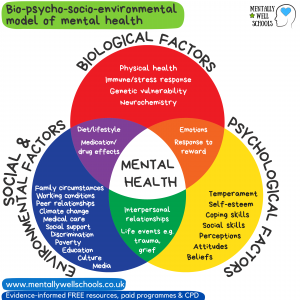
The social and environmental factors suggest that government policymakers have a duty to devise and implement measures which are conducive to better mental health for their populations.
Policies to promote social justice, together with sustained investment, are needed to actively tackle issues such as poverty, racism and discrimination, ensuring timely access to medical and social care for all, alongside policies to avert the climate crisis which threatens to destabilise wellbeing around the world yet further.
However, the cut to Universal Credit and the impending National Insurance hike in the UK, against a backdrop of rising energy costs, threaten to affect lower income households disproportionately, exacerbating poverty and widening socioeconomic disparities.
Rather than rhetoric, governments in the UK and elsewhere need to show that they are genuinely interested in improving ordinary people’s mental and physical wellbeing, and life chances.
What can Schools and their Communities do?
At a community level, people can demand at the ballot box and through other channels that governments prioritise the mental wellbeing of their populations through policies to eliminate some of the root causes and contributing factors to mental ill health and inequality.
At the school level, one way in might be through the recently updated Public Health England guidance for schools and colleges on Promoting children and young people’s mental health and wellbeing. This sets out eight principles as shown in this diagram:
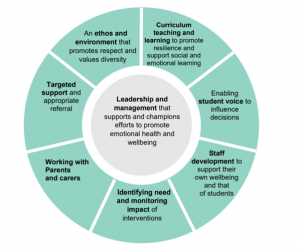 [image source: Public Health England]
Along with the eight principles are eight key questions, three of which we’ll discuss here, with some suggestions for practical approaches and tools.
1️⃣ How does the school or college’s culture promote respect, inclusivity and value diversity?
Many schools in the UK and internationally will have policies in place to guide practice and promote respect, inclusion and diversity across characteristics such as neurodiversity, mental and physical health, ethnicity, faith, sexual orientation or gender identity.
The challenge is to make these a living part of the culture of the school, reflected by pupils and staff in their daily conduct. Two key components are:
- Ongoing professional development training for staff around these complex issues
- Opportunities within the curriculum for students to explore these potentially sensitive topics with trained staff and relevant outside speakers.
Even more importantly, when genuine respect, inclusivity and valuing of diversity are modelled and lived daily by all school staff and students (and parents) towards one another, these values become ingrained among all members of the school community.
Dr Neil Hawkes, the founder of Values-Based Education, in his guest blog, set out ways of putting this into action, for example:
Use the language of values when talking with children, ‘Well done, you were very respectful’.”
Dr Hawkes elaborates further, including the key part played by staff as true role models through their own ethical and reflective practice:
The process of implementing such an approach is challenging, as it requires each person to hold a mirror up to their thoughts and actions. The benefits are worth the effort: individuals feel transformed and empowered to be self-leaders.
Embedding such an active ethical compass has shown to positively affect pupils’ behaviour, their thinking, the quality of their schoolwork: and most importantly for me, their mental health and wellbeing.”
Training to promote inclusion and equality in schools would include topics such as racism and anti-racism, as well as knowledge of and strategies around Adverse Childhood Experiences (ACEs) including discrimination, poverty and a host of other pivotal developmental factors.
2️⃣ What focus is given within the curriculum to social and emotional learning and promoting personal resilience?
As we wrote in a recent and widely read magazine article, embedding learning about emotion regulation and mental health into the school curriculum is a key part of any effective school strategy to support and improve children’s and young people’s mental wellbeing and life outcomes.
In addition to a comprehensive whole-school PSHE curriculum, schools can consider implementing more focussed programmes to equip students with evidence-based skills to manage their emotional and social wellbeing.
Strategies from evidence-based approaches which have been efficacious in school settings, such as Cognitive Behavioural Therapy (CBT), Social and Emotional Learning (SEL), and Dialectical Behaviour Therapy (DBT), are invaluable.
Our programmes at Mentally Well Schools are mostly based on DBT, which teaches a toolkit of skills drawing on CBT, Social and Emotional Learning, and Mindfulness – and are underpinned by a Trauma-Informed Approach.
3️⃣ How are staff supported in relation to their own health and wellbeing and to be able to support student wellbeing?
The 2020 Education Support Network Teacher Wellbeing Index from the first few months of the pandemic highlighted the concerning disparity between the mental wellbeing of educators in comparison with the general population:
Education professionals in the U.K. displayed much higher levels of depression (32%) than the general population (19%) (ONS, 2020a).”
At a time when children and young people’s mental health has been plunged deeper into crisis by the pandemic, supporting staff in schools is even more important than ever – both for their own wellbeing, and because young people need the support of experienced school staff to nurture their psychological recovery.
The graphic which follows shows the scale of the teacher wellbeing crisis in England, Wales and Northern Ireland, and in international schools globally.
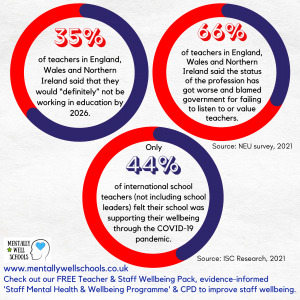
It’s clear that government policymakers in the UK at least need to begin listening to educators and make the required policy shifts to prevent a mass exodus of teachers from the profession.
It also falls to school policymakers to prioritise staff wellbeing. This graphic shows some things which school leaders can do to make a positive impact on teacher mental health, and also to help prevent staff burnout.
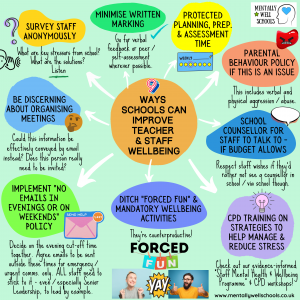
For more resources to improve staff wellbeing, download our free Teacher & Staff Wellbeing resource pack, look at the 15-module Staff Mental Health & Wellbeing Programme, and consider CPD training.
In terms of training to support student wellbeing, in-depth knowledge of the impact of Adverse Childhood Experiences (ACEs) and trauma would be essential, enabling school staff to understand the potentially far-reaching effects of the pandemic, childhood abuse, poverty, bullying, racism and discrimination, among others.
This free 1-hour online training about Adverse Childhood Experiences and early trauma could be a helpful introduction for staff in schools. For more comprehensive training on Trauma-Informed Practice and strategies for use in schools, consider CPD training for all staff.
In what is looking likely to be an increasingly fractured and precarious post-pandemic world, a Trauma-Informed approach is becoming more and more essential in schools, just as in broader society.
Conclusion
This year’s theme for World Mental Health Day draws attention to the inequalities which obstruct mental wellbeing. The UN highlights the key role of governments: “Lack of investment in mental health disproportionate to the overall health budget contributes to the mental health treatment gap.”
Austerity has led to worsening poverty, with its known deleterious impacts on mental health. Chronic underinvestment in mental health and public services in many countries including the UK has caused a widening gulf in access to mental health provision. The COVID-19 pandemic has amplified the effects.
Incidents such as the murder of George Floyd in 2020 have highlighted societal issues which perpetuate inequality. For change to happen, stakeholders need to make their voices heard at the ballot box and through other channels to demand that governments implement well-thought-out policies to tackle root causes of inequity and ensure sustained financial investment in key areas.
Although we can’t hope to change the world within schools, we can make a valuable contribution within our communities to promoting equality and supporting mental wellbeing, laying the foundations for a better world.
While individual teachers may not have the profile of Marcus Rashford in the wider world, each teacher has a high profile with the children and young people that they meet every day – and just as Barack Obama said of Marcus Rashford, “are already making changes and being positive forces in their communities”.

Ava S. Hasan & The Mentally Well Schools Team
Ava Shabnum Hasan is the Founder of Mentally Well Schools and an Associate Lecturer on the ‘MSc Mental Health & Wellbeing in Education’ at Buckinghamshire New University. An LSE graduate with a degree in Government/Political Science, and a subsequent 20 year career in education, she is an advocate for policies and practices which promote the mental wellbeing of school children, adolescents and staff.
www.mentallywellschools.co.uk An online platform of free mental health and wellbeing resources, paid evidence-informed programmes and CPD training, to improve student and staff mental health, provided by a Psychotherapist and a former SENDCo/Senior Leader.
P.S. If you have something to say in response to this post, please make a comment below. We’d welcome your thoughts!
Leave a Reply